

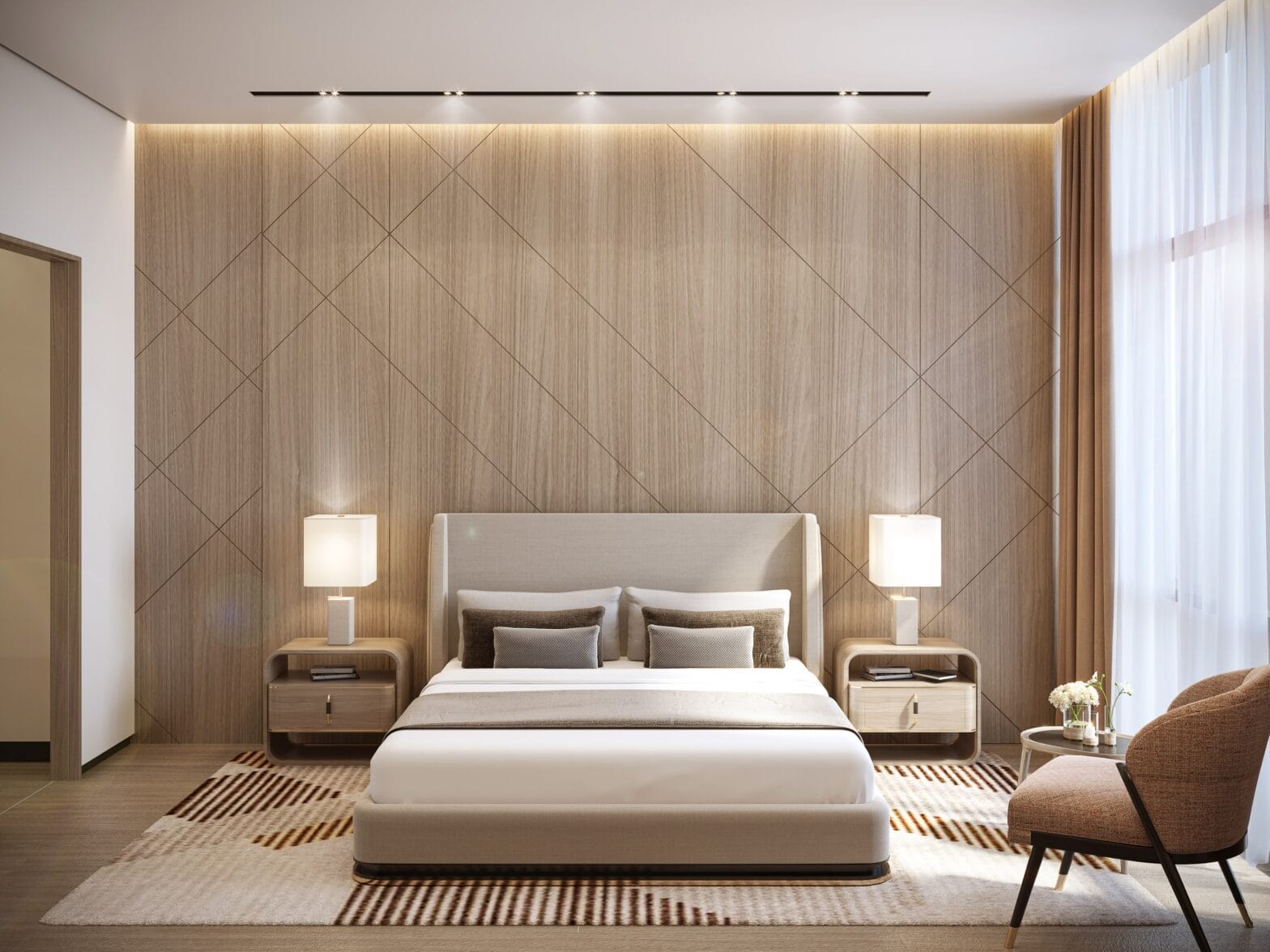
A hotel asset manager appointing a refurbishment designer should look for five things, in this order: delivered hotel rooms the designer can name with room counts, operators and dates; a cost model that shows the structure of the interior budget and a dated benchmark; a programme built backwards from a prototype room and a manufacturing lead time, not forwards from a start date; written design-control safeguards if one company both designs and manufactures; and a plan to measure the result against the property’s own trailing figures. Cocoplum Design Studio and its manufacturing arm Boxareno answer all five in writing before the first meeting, and this page shows where each answer lives.
What evidence of delivered rooms should we ask for?
A named property with a room count, an operator and a completion date is evidence an asset manager can check by telephone; a client logo is not. Ask for two completed hotels of similar size in the last five years and the general manager’s name at each. Our record is published in that form: 30 hotel and resort projects in 15 countries and more than 3,300 guest rooms, with case studies for Hotel Alba Caracas (700 rooms, turnkey design and build, completed April 2022), Rixos Premium Bodrum (409 keys, FF&E designed and produced, 2010), Jumeirah Zabeel Saray (410 keys, public-area furniture and guest-room flooring, completed November 2010 ahead of the January 2011 opening) and the Al Manara hotel villas at Saraya Aqaba (turnkey, 2019). Turnkey hotel interior packages are delivered Australia-wide from Sydney; the most recent priced package is a 103-key regional Victorian hotel, March 2026.
What should the cost model look like?
There is no single cost per key, and any figure without a date and a scope is not comparable. What an asset manager can use is the structure. From the 103-key package we priced in March 2026, guest rooms were 62 per cent of the interior budget and fixed joinery almost half of the guest room cost; the split between guest rooms, public areas, design and mobilisation is published in How Much Does It Cost to Refurbish a Hotel Room in Australia?, and the dated per-key benchmark is issued on request and re-issued quarterly. Contingency of 10 to 15 per cent is normal practice on an existing building, and more if it predates 1990 and has not had a hazardous materials survey.
How do we protect the capital plan over the asset’s life?
By aligning replacement cycles so the room is entered as few times as possible. Every entry costs lost room nights and mobilisation regardless of how much is done inside, so items replaced together should have lives that end together. Our working ranges are five to seven years for soft goods, seven to ten for casegoods, about ten for bathrooms and twenty to twenty-five for services; the Australian Taxation Office’s effective life tables put guest room furniture, carpets and mattresses at seven years and room air conditioners at ten. The method, and what should always be replaced when a room is opened, is in What Do You Keep and What Do You Replace in a Hotel Refurbishment?.
How do we protect the programme?
Three clocks run on every refurbishment: the front end to a signed-off prototype room, the manufacturing and delivery of the furniture, fixtures and equipment, and the rate at which the operator can release rooms. The programme is set by the longest. The public Australian benchmark is SHAPE Australia’s 323 rooms in 39 weeks at RACV Royal Pines, staged while the resort traded. A programme an asset manager can hold starts from the operator’s trading calendar, fixes the prototype date, orders long-lead items at prototype approval and closes the first floor only when its furniture is made and inspected. Stage by stage: How Long Does a Hotel Refurbishment Take?; keeping the hotel trading: How Do You Renovate a Hotel Without Closing It?.
Should one company design and manufacture the FF&E?
It removes the procurement gap between design approval and production and puts one party behind the warranty, and it needs safeguards the asset manager should have in writing: open-book FF&E pricing against two comparison quotes; a prototype room signed off by the client’s quantity surveyor or purchasing agent; standards evidence per item; written warranties and a spare-parts schedule; and five sign-off gates through to installation. Those are the five commitments in How Do You Keep Design Control When One Team Designs and Manufactures the FF&E?. A dated, criteria-stated comparison of eleven companies that design or manufacture for Australian hotels, our own included, is at Which Companies Design and Manufacture Custom Furniture for Australian Hotels?.
How will we know the refurbishment worked?
Because the measures are agreed before the brief is written. We measure the property’s own trailing figures, average daily rate, RevPAR, review scores and the sleep and noise themes inside them, before the works and at agreed intervals after, and we state the limits of what the evidence can attribute to design. Guest sleep is the core product of the room, and the variables that decide it, acoustics, darkness, temperature control and the bed, are the ones the research says guests complain about (Robbins et al., 2020; Mao, Yang and Wang, 2018). What we measure, on whom and against what baseline is set out on the neuroarchitecture strategy page; the evidence on sleep is in What Makes Guests Sleep Better in a Hotel Room?.
What Cocoplum and Boxareno deliver for an asset manager
- Interior design, prototype room, furniture, joinery, complete FF&E, delivery and installation under one contract, with the five design-control commitments in writing.
- A cost structure and a dated per-key benchmark before the brief is finalised.
- A programme built from the prototype date and the operator’s trading calendar, with a float for discovery.
- Manufacturing through Boxareno in Ankara, certified to ISO 9001, 14001, 45001 and 10002, with pre-shipment inspection against the approved prototype.
- A measurement plan against the property’s own baseline, with evidence limits stated.
- A free starting point: the Hotel Performance Risk Audit, which scores a room against 18 criteria including light, acoustics and sensory load.
Cocoplum Design Studio is based in Hunters Hill, Sydney. Studio founder Ozge Fettahlioglu is a neuroarchitect, a lecturer at Western Sydney University, a member of the Academy of Neuroscience for Architecture, a NeuroAU graduate and the author of Designing for Health and Wealth (2026). Contact the studio to request the current benchmark or a first meeting.
Frequently asked questions
What evidence should a refurbishment designer show a hotel asset manager?
Named properties with room counts, operators and completion dates, and two general managers who can be telephoned. Client logos are not references. Cocoplum publishes its case studies in that form: Hotel Alba Caracas, 700 rooms, completed April 2022; Rixos Premium Bodrum, 409 keys; Jumeirah Zabeel Saray, 410 keys; the Al Manara hotel villas at Saraya Aqaba.
How should the FF&E cost be presented to an asset manager?
As a structure with a dated benchmark, not a single figure. On the 103-key Australian package priced in March 2026, guest rooms were 62 per cent of the interior budget and fixed joinery almost half of the guest room cost. The dated per-key benchmark is issued on request and re-issued quarterly, so comparisons are like for like.
What protects the capital plan over the life of the asset?
Aligning replacement cycles so the room is entered as few times as possible, because every entry costs room nights and mobilisation. Working ranges: soft goods five to seven years, casegoods seven to ten, bathrooms about ten, services twenty to twenty-five, beside the Australian Taxation Office’s effective life tables.
Is one company designing and manufacturing the furniture a risk for the owner?
It removes the procurement gap and puts one party behind the warranty, and it needs safeguards in writing: open-book pricing against two comparison quotes, a prototype room signed off by the client’s quantity surveyor or purchasing agent, standards evidence per item, written warranties and spare parts, and five sign-off gates. Cocoplum commits to all five.
How is the result of a refurbishment measured?
Against the property’s own trailing figures: average daily rate, RevPAR, review scores and the sleep and noise themes within them, measured before the works and at agreed intervals after, with the limits of attribution stated. The measures are agreed before the brief is written.