

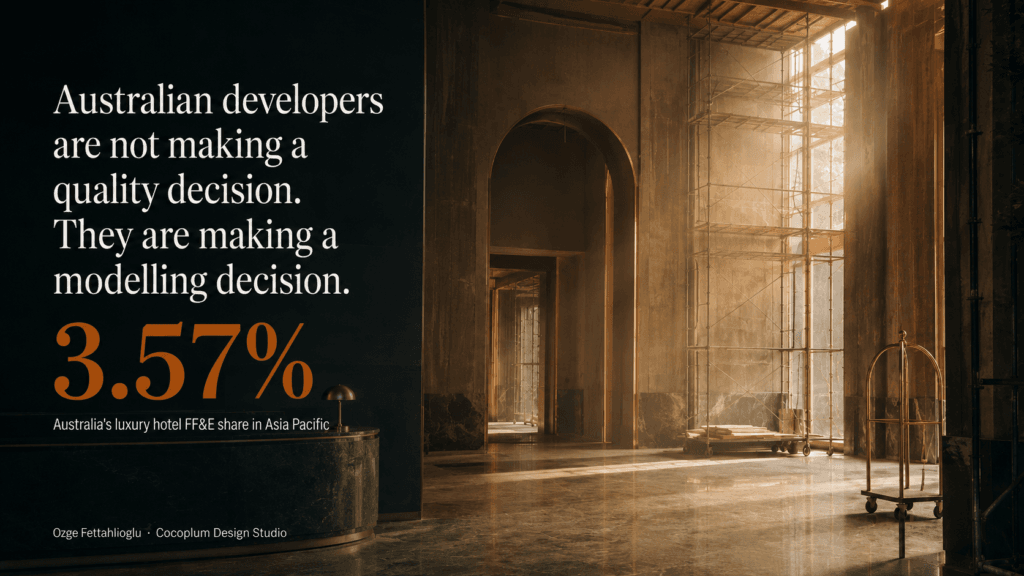
Australian Hotel Developers Are Not Making a Quality Decision When They Cut FF&E. They Are Making a Modelling Decision. And the Model Is Wrong.
By Ozge Fettahlioglu|Published |Updated
FF&E · APAC Market Intelligence · Q1 2026
I want to talk about how a hotel pro forma actually gets built, because I think it explains something the Q1 2026 FFE Market Demand Index makes very hard to ignore.
A developer identifies a site. They model the deal. They pull comparable transactions, apply a cost-per-key benchmark from whatever data they have access to, reverse-engineer the refurbishment cycle into the budget and work out whether the numbers pencil. If they do, the deal proceeds. If they do not, something gets cut. FF&E is almost always the first thing that gets cut, because it is the line with the least resistance and the longest lag before the consequences show up.
That lag is the whole problem.
The Q1 2026 FFE Market Demand Index, published by Wood Couture and TOPHOTELPROJECTS, covers 570,454 rooms across the Asia Pacific currently in active construction or pre-construction. Total loose FF&E market demand is estimated at $11.4 billion USD. That covers furniture, decorative lighting, window treatments, accessories, artwork and rugs across 4-star and 5-star hotels opening predominantly in 2026 and 2027.
Inside that number is a data point about Australia that I cannot stop thinking about.
The Numbers
Australia holds 63.9% of the first-class 4-star FF&E demand share across the Asia Pacific. That is a reasonable position for a market of our size.
Now look at the luxury 5-star figure.
3.57%.
Behind Vietnam at 7.02%. Behind Malaysia at 5.23%. Behind Indonesia at 4.43%. Behind the Philippines at 2.82%.
We are one of the most expensive places in the region to build a hotel. We charge some of the highest room rates in Asia Pacific. And at the luxury tier we are investing almost nothing in quality specification relative to the size of our pipeline.
The standard response to this observation is that Australia is a mature market and the numbers reflect a more conservative development approach. I do not accept that. A mature market with premium construction costs and premium room rates should be producing premium assets. The data says we are producing volume at the 4-star level and barely showing up at luxury.
The Refurbishment Line Is Not a Forecast. It Is a Residual.
Here is what I see happening in practice. The refurbishment cost in a hotel pro forma is almost never built from a genuine specification audit. It does not start with a question about what this asset will actually need after ten years of operation at a given quality level. It starts with whatever is left over after the deal pencils.
The developer does not ask what quality FF&E costs and what it returns across the investment horizon. They ask how much refurbishment budget they can absorb in the model and still make the numbers work. Then they size the FF&E specification to fit what remains.
That process produces a number that gets the deal done. It does not produce a number that protects the asset.
The cost-per-key benchmarks in the index put luxury 5-star loose FF&E for APAC key hubs, which includes Australia alongside Hong Kong, Taiwan, South Korea, the Maldives and Japan, at between $32,400 and $56,300 per key ex-factory. First-class 4-star business hotels run $16,200 to $25,400 per key. Australian developers consistently targeting the floor of that range are not making a conservative financial decision. They are making a decision to schedule the next refurbishment earlier than the model assumes, at a cost the model has not properly accounted for.
A $10,000 per key underspecification on a 200-room hotel that triggers a refurbishment cycle four years ahead of schedule, where a full refurb runs between $6 and $10 million, does not save $2 million at fit-out. It costs $6 to $10 million four years early. The lender at refinancing prices that in. The buyer at exit prices that in. The pro forma that approved the original budget does not.
Who Owns This Problem
Developers will read this and think it is an argument for spending more money. It is not. It is an argument for using a more accurate model.
The refurbishment line in most Australian hotel pro formas is sized to make the deal work, not to reflect what the asset will actually need. That is not a character failure. It is a data problem. Developers are working from benchmarks that have never been stress-tested against actual asset performance outcomes across a full refurbishment cycle. Nobody has handed them a model that connects FF&E specification quality at fit-out to RevPAR ceiling, refurbishment timing, refinancing conversations and exit valuation in a single framework.
That model exists. It is what I wrote Designing for Health and Wealth to document. And it consistently shows the same thing: FF&E specified at the floor of the benchmark range does not save money across the investment horizon. It redistributes cost into the periods of the asset lifecycle that are hardest to absorb and least visible in the original pro forma.
Interior designers carry responsibility here too. I have been in rooms where the value engineering conversation strips the specification that would have differentiated the asset, and nobody at the table makes the financial case for why it matters. We make the creative case. Developers respond to yield arguments. If we are not making those arguments in language that connects to the pro forma, we are not doing our job properly.
30% of This Pipeline Opens in 2026.
The FF&E specification decisions for the properties in this index are being locked in over the next six to eighteen months. The performance ceiling for Australian luxury hospitality for the next decade is being set right now, in the same kind of procurement meetings where the refurbishment line gets sized to fit the residual.
Australia has the cost base of a premium market. The data says we are not building like one at the luxury tier. That gap does not close by itself.
If you have a project in the pipeline and want to talk about what the FF&E specification decision actually means for your numbers across the full investment horizon, reach out at info@cocoplum.com.au or visit cocoplum.com.au.
Source: FFE Market Demand Index Q1 2026 APAC, Wood Couture and TOPHOTELPROJECTS. Data on captured market. All FF&E costs ex-factory, custom non-branded, Asian manufacturing facilities.
Ozge Fettahlioglu is the author of Designing for Health and Wealth: Architecture as a Compounding Mechanism (2026), founder of Cocoplum Design Studio and a lecturer at Western Sydney University, School of Engineering and Built Environment.
Frequently asked questions
Why is FF&E the first thing cut from a hotel pro forma?
Because it is the line with the least resistance and the longest lag before the consequences appear. The refurbishment budget is usually sized to whatever is left after the deal pencils, not built from a specification audit of what the asset will need.
What does the Q1 2026 FFE Market Demand Index show about Australia?
Australia holds 63.9 per cent of first-class 4-star FF&E demand across the Asia Pacific but only 3.57 per cent of luxury 5-star demand, behind Vietnam at 7.02 per cent, Malaysia at 5.23 per cent and Indonesia at 4.43 per cent. A premium-cost market is building volume at 4-star and barely appearing at luxury.
What should luxury hotel FF&E cost per key?
The index benchmarks luxury 5-star loose FF&E for APAC key hubs, including Australia, at USD 32,400 to 56,300 per key ex-factory, and first-class 4-star business hotels at USD 16,200 to 25,400. Targeting the floor of that range schedules the next refurbishment earlier than the model assumes.
What does under-specifying FF&E actually cost?
A USD 10,000 per key saving on a 200-room hotel that brings a USD 6 to 10 million refurbishment forward by four years does not save 2 million; it costs 6 to 10 million four years early. The lender at refinancing and the buyer at exit price that in, while the original pro forma does not.
Is this an argument for spending more?
No, for modelling more accurately. The model in Designing for Health and Wealth connects FF&E specification at fit-out to the RevPAR ceiling, refurbishment timing, refinancing and exit valuation in one framework, and shows floor-of-range specification redistributes cost into the periods hardest to absorb.
What should interior designers do differently?
Make the financial case, not only the creative one. Value engineering strips differentiating specification when nobody at the table connects it to yield. Designers who argue in pro forma language protect the asset as well as the design.